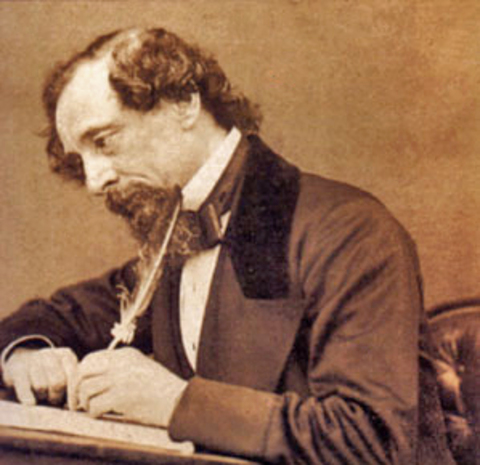
Charles Dickens' Life
Charles Dickens was born in Landport, Hampshire, during the new industrial age, which gave birth to theories of Karl Marx. Dickens's father was a clerk in the navy pay office. He was well paid but often ended in financial troubles. In 1814 Dickens moved to London, and then to Chatham, where he received some education. The schoolmaster William Giles gave special attention to Dickens, who made rapid progress. In 1824, at the age of 12, Dickens was sent to work for some months at a blacking factory, Hungerford Market, London, while his father John was in Marshalea debtor's prison. "My father and mother were quite satisfied," Dickens later recalled bitterly. "They could hardly have been more so, if I had been twenty years of age, distinguished at a grammar-school, and going to Cambridge." Later this period found its way to the novel LITTLE DORRITT. John Dickens paid his £40 debt with the money he inherited from his mother; she died at the age of seventy-nine when he was still in prison.
In 1824-27 Dickens studied at Wellington House Academy, London, and at Mr. Dawson's school in 1827. From 1827 to 1828 he was a law office clerk, and then a shorthand reporter at Doctor's Commons. After learning shorthand, he could take down speeches word for word. At the age of eighteen, Dickens applied for a reader's ticket at the British Museum, where he read with eager industry the works of Shakespeare, Goldsmith's History of England, and Berger's Short Account of the Roman Senate. He wrote for True Sun, Mirror of Parliament, and the Morning Chronicle. Dickens gained soon the reputation as "the fastest and most accurate man in the Gallery", and he could celebrate his prosperity with "a new hat and a very handsome blue cloak with velvet facings," as one of his friend described his somewhat dandyish outlook. In the 1830s Dickens contributed to Monthly Magazine, and The Evening Chronicle and edited Bentley's Miscellany. These years left Dickens with lasting affection for journalism and suspicious attitude towards unjust laws. His career as a writer of fiction started in 1833 when his short stories and essays to appeared in periodicals. 'A Dinner at Poplar Walk' was Dickens's first published sketch. It appeared in the Monthly Magazine in December 1833. It made him so proud, that he later told that "I walked down to Westminster Hall, and turned into it for half an hour, because my eyes were so dimmed with joy and pride, that they could not bear the street, and were not fit to be seen there." SKETCHES BY BOZ, illustrated by George Cruikshank, was published in book form in 1836-37. THE POSTHUMOUS PAPERS OF THE PICKWICK CLUB was published in monthly parts from April 1836 to November 1837.
Dickens's relationship with Maria Beadnell, the daughter of a banker, whom he had courted for four years, ended in 1833. Three years later Dickens married Catherine Hogart, the daughter of his friend George Hogarth, who edited the newly established Evening Chronicle. With Catherine he had 10 children. They separated in 1858. Some biographers have suspected that Dickens was more fond of Catherine's sister, Mary, who moved into their house and died in 1837 at the age of 17 in Dickens's arms. Eventually she became the model for Dora Copperfield. Dickens also wanted to be buried next to her and wore Mary's ring all his life. Another of Catherine's sisters, Georgiana, moved in with the Dickenses, and the novelist fell in love with her. Dickens also had a long liaison with the actress Ellen Ternan, whom he had met by the late 1850s.
Dickens's sharp ear for conversation helped him to create colorful characters through their own words. In his daily writing Dickens followed certain rules: "He rose at a certain time, he retired at another, and, though no precisian, it was not often that arrangements varied. His hours for writing were between breakfast and luncheon, and when there was any work to be done, no temptation was sufficiently strong to cause it to be neglected. The order and regularity followed him through the day. His mind was essentially methodical, and in his long walks, in his recreations, in his labour, he was governed by rules laid down for himself - rules well studied beforehand, and rarely departed from.

No hay comentarios:
Publicar un comentario